Laser tattoo removal works through a staged biological process, so the visible fading after one appointment does not predict the final result. Before you book, you need to understand how ink responds, whether your skin and medical history affect treatment, what recovery involves, and how to compare a treatment plan with realistic expectations.
Key takeaways
- Expect multiple sessions because your immune system clears fragmented ink gradually.
- Ask which laser wavelength matches each ink colour and your skin type.
- Protect treated skin from sun exposure and follow wound-care instructions.
- Avoid home removal creams, abrasive methods, and unqualified laser operators.
How laser tattoo removal works and why one session is not enough
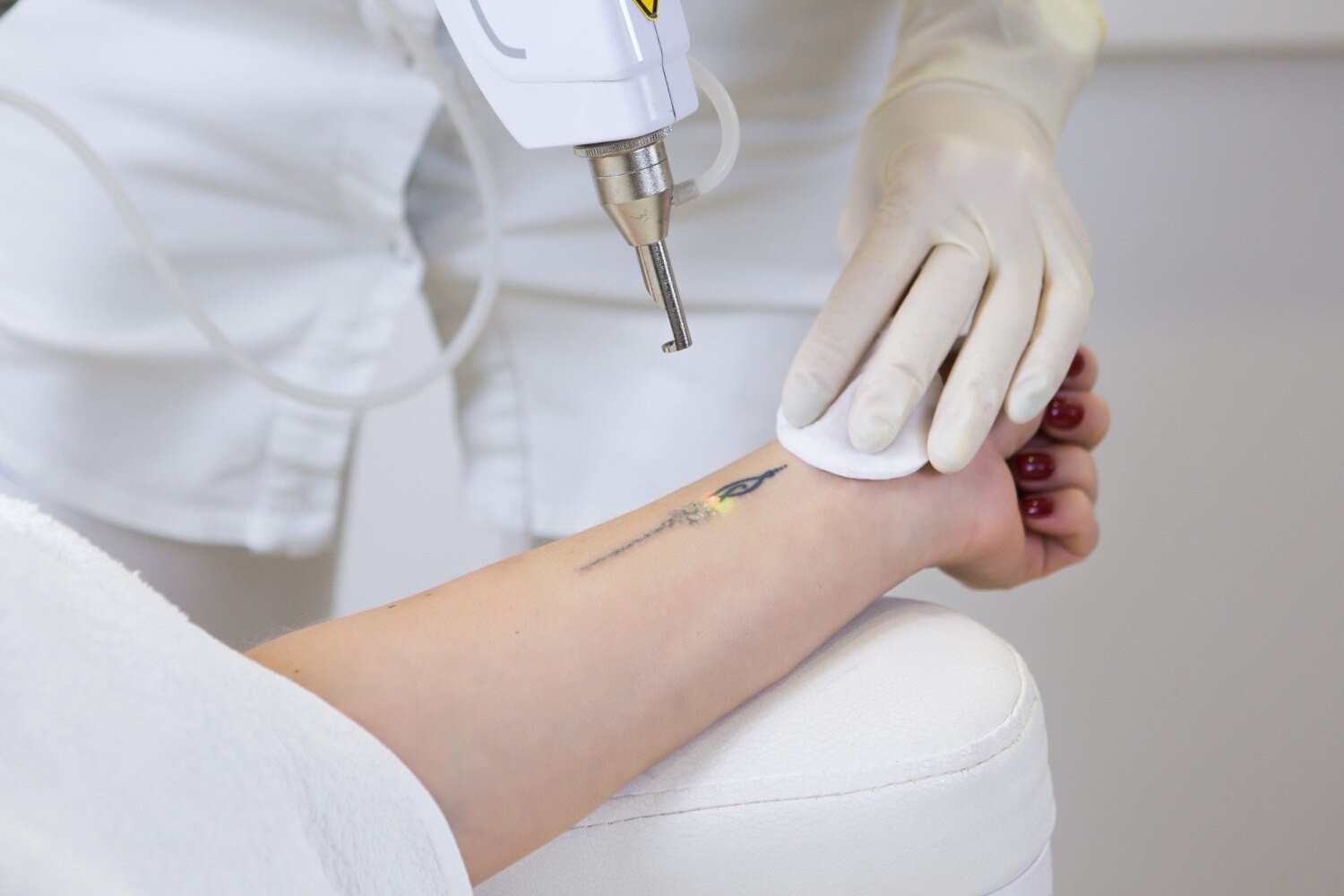
Laser tattoo removal works by delivering Q-switched or picosecond laser pulses that target ink with selective photothermolysis and photoacoustic effects. The energy breaks pigment into smaller particles; your immune system and lymphatic system then clear those particles gradually. The laser does not simply vaporise all the ink during one appointment.
Ink colour affects the tattoo removal timeline:
| Ink colour | Usual response | Why it matters |
|---|---|---|
| Black or dark blue | Often responds faster | Commonly absorbs 1064 nm laser energy well |
| Green or turquoise | Often fades more slowly | Pigment chemistry can resist available wavelengths |
| Yellow or mixed colours | Variable and slower | Several pigments may need different wavelengths |
Healing and clearance require multiple laser tattoo removal sessions. The usual interval is 6–8 weeks between tattoo removal sessions, allowing the epidermis to recover and your body to remove fragmented pigment. Treating too soon can increase inflammation without speeding clearance.
A small tattoo may take only minutes to treat, while a large, dense tattoo requires more laser passes and a longer appointment. Dense professional tattoos often need six or more sessions because they contain concentrated, deeply placed, layered ink. Amateur tattoos can still be unpredictable.
No provider can promise a fixed number of appointments. Ghosting, residual pigment, incomplete clearance, or textural change can remain, especially with green, turquoise, yellow, and modern mixed inks. Some pigments can also trigger delayed allergic or inflammatory reactions after fragmentation.
Are you a suitable candidate for laser tattoo removal?
A laser tattoo removal candidacy assessment starts with the tattoo, not a standard package. The clinician should review its age, ink depth, professional or amateur application, size, location, and pigment colours.
Dense professional ink often behaves differently from shallow amateur ink, while white, flesh-coloured, or cosmetic pigments containing titanium dioxide or iron oxide can darken after laser exposure.
Tattoo removal darker skin requires conservative settings because epidermal melanin absorbs some laser energy, raising the risk of burns, hyperpigmentation, or hypopigmentation. Recent tanning increases that risk, so strict ultraviolet avoidance and a test spot may be necessary.
Use this pre-booking checklist:
- Postpone treatment over an active skin infection, open wound, or inflamed rash.
- Disclose keloid risk tattoo removal, hypertrophic scars, poor wound healing, or previous textural changes.
- Report tattoo allergy, severe red-ink reactions, eczema, psoriasis, or another inflammatory skin disease.
- Discuss photosensitivity and laser treatment if sunlight causes unusual reactions or you take a light-sensitive medicine.
- Tell the clinician if you are pregnant or breastfeeding; treatment may need to wait.
- Bring every current medicine and supplement, including drugs that affect healing, bleeding, or light sensitivity.
The clinician should document pigment colours, tattoo age and location, prior removal attempts, current medicines, pregnancy status, recent tanning or ultraviolet exposure, allergies, and scarring history. Ask what the test spot will monitor: unexpected pigment darkening or an unusually strong inflammatory response.
What happens during a session, and what will recovery feel like?
1. What happens during laser tattoo removal begins with a medical history and consultation. The clinician records medicines, allergies, healing problems, keloids, recent tanning, pregnancy status, and previous tattoo treatments, then examines the tattoo’s colours, depth, size, and skin condition.
2. You receive wavelength-specific protective eyewear before treatment. A test spot may be treated when pigment, skin tone, or a previous reaction creates uncertainty; it can reveal unexpected darkening or excessive inflammation.
3. During the laser passes, tattoo removal pain often feels like rapid snaps or a rubber band striking the skin. Immediate frosting or whitening is common, followed by redness, swelling, and sometimes pinpoint bleeding. Cooling is applied during or after the passes.
4. The clinician may cover the area with a dressing and provide written aftercare. Small blisters can form, then dry into crusts. Do not pick either one: opening the surface raises infection and scarring risk.
Tattoo removal recovery varies with ink density, treatment settings, skin type, and your healing response. Redness and swelling often ease over several days, while blistering and crust formation can take about 7–14 days to settle; colour changes and pigment clearance continue longer. Frosting or blistering does not prove complete clearance.
Ask for clinical review if redness spreads, pain worsens, pus appears, fever develops, or the area has not begun healing within the expected window. Avoid treating again before the skin has healed and the planned interval has passed.
How to compare laser systems and treatment providers
A suitable laser depends on the ink, your skin type, and how the provider plans to adjust treatment—not on the machine’s marketing name. Q-switched versus picosecond laser systems both deliver short, high-power pulses, but their pulse durations and settings differ; neither is automatically best for every tattoo.
| System or feature | What it means | What to compare |
|---|---|---|
| Q-switched laser | Nanosecond pulses fragment pigment | Proven option with appropriate wavelength and settings |
| Picosecond laser | Shorter pulses create strong photoacoustic effects | Useful for selected pigments, but operator skill still matters |
| 1064 nm | Commonly targets black and dark-blue ink | Often preferred when reducing melanin absorption matters |
| 532 nm | Treats many red, orange, and yellow pigments | Requires careful assessment because shorter wavelengths interact more with melanin |
| 755 nm or 694 nm | Used for some green and blue pigments | Selection depends on the exact pigment and skin response |
Ask how the tattoo removal laser wavelength was chosen, what spot size and pulse settings will be used, and how cooling will protect the surrounding skin. Settings should change with skin tone, tanning, tattoo density, and healing—not follow a fixed template. A test spot can expose unexpected inflammation or darkening.
Treat white, flesh-coloured, and cosmetic pigments cautiously. Titanium dioxide and iron oxide can turn grey, black, or darker after laser exposure.
Ask who performs the procedure, how pigment ingredients and previous reactions are assessed, and what will change between sessions. A dermatologist-led plan at SKIN ASTETICS CLINIC is especially useful for multicolour tattoos, cosmetic pigment, darker skin, or previous scarring or pigment reactions.
Related service
Tattoo Removal Professional Tattoo Removal Services at Skin Astetics Clinic Are you looking for a safe, effective way to remove unwanted tattoos? At Skin Astetics... View service → |
What aftercare protects the treated skin, and when is another method a bad idea?
Clean treated skin gently and follow the dressing and ointment instructions exactly. Laser tattoo removal aftercare is not the time to experiment: do not pick blisters or crusts, and avoid swimming, soaking, tight clothing, and rubbing while the surface remains open.
- Wash your hands before touching the area, then clean it as directed and pat it dry.
- Keep the dressing in place for the stated period. Replace it only as instructed.
- Apply only the recommended ointment, in the specified amount. Ask before using antiseptics, acids, retinoids, creams, or cosmetics.
- Leave blisters and crusts intact. Removing them exposes healing tissue and raises infection and scarring risk.
- Avoid pools, hot tubs, open water, vigorous friction, and exercise that repeatedly rubs the area until it has closed.
- Protect the site from tattoo removal sun exposure. Freshly treated skin may need physical coverage and shade, not sunscreen alone; ask when sunscreen and normal products can safely resume.
Commercial tattoo-removal creams and chemical peels do not reliably reach or remove dermal ink. Their tattoo removal cream risks include chemical burns, dermatitis, infection, and permanent scarring, so a “natural” or over-the-counter label does not make them safe alternatives.
Seek prompt advice for tattoo removal infection signs such as spreading redness, worsening pain, pus, fever, or delayed healing. Delayed allergic or inflammatory reactions can appear as pigment is redistributed; unusual swelling, intense itch, or a spreading rash also needs clinical review.
Frequently asked questions
Why is one laser tattoo removal session not enough?
Laser pulses break ink into smaller particles, but your immune and lymphatic systems clear those particles gradually. The skin also needs time to recover before another session.
Are you a suitable candidate for laser tattoo removal?
A dermatologist should assess your skin type, tattoo age, ink colours, pigment depth, scarring risk, active skin conditions, medications, and history of poor wound healing before treatment.
What happens during a laser tattoo removal session?
The provider cleans and protects the area, then delivers Q-switched or picosecond laser pulses. You may feel snapping or stinging, followed by redness, swelling, tenderness, or blistering during recovery.
How should you compare laser tattoo removal providers?
Ask who performs the treatment, which laser wavelengths are available, how the device suits your tattoo colours and skin type, what eye protection is used, and how complications are managed.
What aftercare protects skin after laser tattoo removal?
Keep the area clean, avoid picking blisters or crusts, follow dressing instructions, limit sun exposure, and use the sunscreen recommended by your clinician after the skin has closed.